|
THE CINCINNATI ENQUIRER Cincinnati, Ohio, U.S.A. 23 April 1910 (page 6)
OLD-WORLD CHITCHAT.
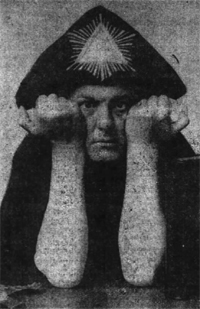
Aleister Crowley, Champion of Modern Mysticism
Of sects there is no end.
Not only is the Christian Church split into hundreds of factions, but the non-church denominations are growing in numbers.
In Paris and London small flocks of men and women, baptized and confirmed in either Protestant or Catholic communions, stoop to the fanaticism and semi-idolatry of Buddhism and other Oriental cults.
And now mediaeval mysticism is revived by a community in London who name themselves Rosicrucians.
This was brought out in a recent suit in London against Aleister Crowley, editor of the Equinox, the Review of Scientific Illuminism, the plaintiff being John Macgregor [MacGregor Mathers], the chief of the order, showing that there is already dissension in its thin ranks,
Mr. Crowley writes flaming editorials against both orthodox and liberal Christianity, and sees happiness only in a belief in the perpetuation of carnal pleasures in the hereafter.
Despite his vagaries Mr. Crowley is a poet of no mediocre talent.
The original Rosicrucians, members of a supposed secret society said to have been founded by Christian Rosenkreuz (Rose Cross) in 1459, and first described in an anonymous work published at Cassel somewhere about 1644, are reported to have claimed exceptional knowledge of the secrets of nature, especially with regard to the transmutation of metals and the way to prolong life, and are further said to have been able to heal the sick in mystical manner and to have aided the poor by turning base metals into gold.
Later rumour asserted that the work issued from Cassel was written by Johann Valentine Andreae (1586-1634), a pastor of Stuttgart, in order that ridicule might be cast on the liking for mystery and secret doctrines that was so prevalent at that time. Andreae, however, denied the authorship of the book.
It is worth noting, perhaps, that in Freemasonry there is an order, or degree, called the Rosy Cross. The Rosicrucians in their present form came into being in 1888 to study mystical philosophy and mysteries of antiquity. |