|
Aleister Crowley Diary Entry Tuesday, 18 September 1923
Die Mars
2.45 a.m. Hagged [dictated The Confessions of Aleister Crowley] till 2.30—Hell!
2.50 Never till now have I worked so steadily & continuously at a single job. It is to all the rest as the Chogo Ri Expedition to may earlier mountain travel.
There is no sense in denying that I am borrowing on my capital by using drugs to keep going. Without them, interest would flag, lust of result intrude, etc., etc.
I spend my life in bed, getting up only at 5 p.m. or thereabouts, as a rule, shaving, dressing, dragging myself to the Maison Doree for dinner. Between drugs & exhaustion, my appetite is poor. I have constant diarrhoea, despite the use of heroin.
I work, as a rule, from about 2 p.m. to after midnight. I cannot sleep, of course; so either I do other work as the whim takes me—poetry, etc.—or read if I can find a book, or do a meditation in a rather half-hearted & informal way.
I calm my nerves, more or less!—with Ether. With luck, I sleep by 4; more often I merely fade away about 7. I breakfast at 9, half asleep; & then doze, perhaps brokenly, till 12 or 1. On waking finally I pull myself together with Heroin & Cocaine, the choice depending on some halfinstinctive impulse. I have got quite out of counting doses. I have acquired the knack of averting immediate ill-effects—bar being bed-ridden!—by using various Magical devices I suppose I average 8 hours or more steady dictation.
My chief worry is the knowledge that sleep fails to refresh me as it should. I wake (too often) depressed, anxious, and with some of the premonitory symptoms of dissociation of Thoughts. There is also the apprehension that when the work is over the reaction (assumed as inevitable by Fear!) will be terrific.
I started to write this note to outline my ideal plan for easing the shock.
It is thus.
I go off on an automobile tour: varying scenery to arouse mild interest, the motion to lull; & the fresh air & jolting to induce natural sleep. (This to be secured if needs must be Luminal or the like.)
Cards, Chess, or light reading and a travelling companion capable of keeping me amused. The use of drugs to be abandoned automatically, by removing the motives for resorting to them. They must be forgotten naturally, as one forgets the habit of coughing till one day one goes out without one’s handkerchief.
I return gradually to Work, but with care to encourage me by showing that it is wanted, to cheer me with tokens of success, and to keep my mind from all anxiety and from dwelling upon depressing or morbid ideas.
As my physical health & energy return, I implement the automobile exercise with walking or games finally restoring my self-confidence by a Tramp hard enough to convince me of my manhood: or some similar test, as a canoe journey, camping our, or some such diversion.
Later. (Still awake, curse it!)
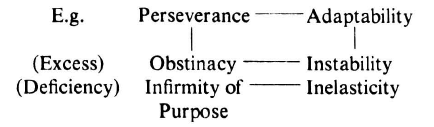
Meditated on Education: Virtues. I must first (this has surely been done by the Greeks—or the Schoolmen) make a list of PAIRS OF VIRTUES with their counterfeits or opposites.
[Note on opposite page:]—or whatever might seem congruous with the ineluctable inevitability of immitigable inneffability as intuition-cumintellectually integrated by inexpugnably apodeictal norms in terms of anthoropopathophenomenal acts—as Mr. Waite [Arthur Edward Waite] might have thought, preliminary to clothing the idea in a respectably larger number of respectably longer words! Each pair must be assigned its proportionate value, and the nature of its relation with each other pair must be indicated.
Note: Excesses & deficiencies are often multiplex, & overlap. E.g. ferocity contains an element of courage. Also: some virtues seem to lack any true complement e.g. Truthfulness. Dare I say ‘Tact’? (Is Tact (Truth + Prudence + Kindness?))
Compare now
[Point 1.] Amiability & its group. This is a secondary composite virtue. A man can get on without it; whereas courage is essential to the work of living. (Dare to eat, & take a chance on poison: or starve!) Courage & amiability are linked thus: latter implies some confidence that one’s attitude will not invite murder, yet (possibly) fear to arouse anger. And in various minor ways.
Point 2. Trace appearance of each pair in the normal child: when it shows, & as a reaction to what immediate exciting cause.
Discuss coincidence of the theoretically proper order of manifestation with the observed order. So divergences indicate errors of environment, & if so, should we adjust environment, or accept it as regrettable reality to tamper with which might give the child a false impression of life?
Point 3. Devise practices, tests, games, courses of instruction, etc., etc., to bring out each virtue & develop it on sound biological principles to its maximum & optimum, always avoiding forcing any one at the expense of the proper growth of any other, as calculation counsels.
E.g. Accuracy should be encouraged, but not at the cost of Muscular Development or the Faculty of Apprehending Values known only approximately.
Point 4. The child must learn to see for itself how one virtue depends on every other, & to combine them intelligently so as to affect any given purpose economically.
E.g. Good judgement is useless without Knowledge to work upon, & to minimize unknown factors which might affect its correctness. Generosity is balked by lack of Sympathetic Comprehension, etc.
Caution is not only useless in an emergency which seems desperate, but is fatal to success, which depends on doing a little more than one’s utmost.
Devise practice, etc., to illustrate these theories & to train the children accordingly.
6 a.m. Tonight my insomnia—as distinguished from my stratagems for turning it to account-has taken a fairly definite form. I have analysed my attitude to this silly drug-dilemma.
Each of the 4 is divisible into many elements. The relative values of these are doubtful: no trustworthy test exists.
One idea is interesting: can it be that a man who (knowing the facts) yields to drugs does so because his Unconscious wants him to die?
I note also with very great gusto that I never ran any real danger till after May ‘21 with its Event, whose nature suggests complete indifference to Malkuth as its moral correspondence, & so recklessness of risk to life & reason its Ordeal.
6.10. Why is it that one takes Cocaine (but no other drug) gluttonously, dose upon dose, neither feeling the need of it, nor hoping to get any good from it? I have found this every time. 3 doses, intelligently taken, secure all one wants. Yet, if the stuff is to hand, it is almost impossible not to go on. One resists successfully (perhaps) for a few nights, then slides into a ‘go as you please’ race without rime or reason. One even goes on while actually cursing oneself for one’s folly. (The one light spot is that so far sudden & complete suppression has been as easy as if cocaine were cabbage!) Folly! not only fear, but the horse sense of not wasting a cherished & possibly irreplaceable stock. Why take 30 doses (or is it 60? I haven’t a ghost of a guess) to get into a state neither pleasant nor in any other way desirable, but fraught with uneasiness, remorse, self-contempt, alarm, discomfort, & irritation at the ever-present thought of ‘Hell! now I have to endure the reaction’ while well aware that with 3 one can get all one wants without one single drawback? One throws 9 sovereigns into the sewer for the pleasure of seeing the tenth turn into a judgment summons for £10!
Watching myself closely while writing this, I notice the intrusion of a feeling that my energy or interest in the work is dulled-oh ever so slightly! This is followed at once by a faint yet acute sense of annoyance—somehow I am reminded of the quick snap of an ill-bred small dog. There is then an automatic impulse to wolf some cocaine. One has rarely time to reflect, even to the extent of ‘Here, heroin will calm you, better take that for a change!’ And yet, if I chance to be dictating at the moment, I am quite content to know that the dose is on the back of my hand, & I go on calmly & happily, sometimes for a long period, taking the dose at last with lordly leisurely decorum.
The interest centres in the ‘snap’-thought. It resembles the reaction when one carelessly burns one’s finger, slightly but unexpectedly. The surprise throws one almost completely, though momentarily, off one’s conscious balance. One snatches the finger away with quite needless violence. To withdraw it an inch would be ample: but one jerks back a yard!
Next, into one’s mouth it pops, still automatic, like a conjuring trick. No degree of conviction that the act is useless would rid one of the habit, I feel sure: nothing short of Liber III would cure it.’
Note also: when I had only Heroin & Ether I used to crave for cocaine to round out the revel! Now, after some weeks with all 3, though full up to the neck, there is sub-conscious hunger in some ways more unpleasant.
The fact is, all states intermediate between sleeping & waking annoy me.
Those characterized by dissociation of Thoughts are of course terrible—even to me, with all I know & can! But even the impatience, petulance, fatigue plus awakeness, etc., are hellish.
Oh well . . . anon!
7.10 a.m. (Dictated to Alostrael [Leah Hirsig].)
Callousness is a function of fear, especially the fear of death: men invent it to protect themselves from suffering caused by seeing others suffer & transferring their pain to oneself by sympathy & imagination. The idea is to protect one’s sensitive spots from all external stimuli not directly connected with them. It is a bad plan. The sore place hurts all the more when touched by something which it cannot evade. A vicious circle is started. The man hardens his heart still more against others thereby decreasing his real power to endure & transcend.
7.55 a.m. (after breakfast). 1. Remove all false will. 2. Remove all complexes which interfere with the True Will. 3. Finally, don’t humour them by so much attention, let them drop out of your life.
You know how with other appetites one takes a fancy to a certain dish for a long time—then cuts it out. Besides these whimsical cases of sudden aversion are those where one drops a thing gradually without knowing it, & that sometimes when one is most anxious to keep it up. Example: I make a violent scene in my soul about being too fat or some similar horror. I decide to do a daily exercise to abate the nuisance. The first few days I keep up to the mark; after that I forget; remember; kick myself, resume with redoubled enthusiasm, forget again, & either don’t remember at all or take the matter lightly if I do. Irregularities increase; when I remember I resent having to go through the weary routine. The whole thing tails off till at last something reminds me; one reflects, & feels sure it is at least a month since the last practice. Reflecting more deeply, one is annoyed to have to admit that one cannot conceive how one broke down or even when. The proper answer is that the practice being thrust violently into one’s daily life as an emergency measure it cannot take root unless so really essential to wellbeing that it becomes in the course of years of habit as natural as eating. With certain men Yoga practices; with others Ceremonial Rites may assume this importance. With such exceptions the intruder jostles his neighbours, he being there by the Master’s orders they dare not raise any objection. They pretend to be quite pleased at rearranging their routine to make room for him. But in their hearts they are resolved to push him out. They find a million tricks to keep the Master in ignorance & when they succeed in getting rid of him his disappearance is only noticed long after through an accident. Their best stunt is to be so busy with their duties that they forget the new limitations & perform their previous task in full thus squeezing him out. They do their work so well & look so cheerful that irregularity passes unsuspected. Further, the new servant having been engaged to cope with some menace to the household, the general cheerfulness to which he has contributed of course by this work, makes the Master forget why he engaged him & so his absence excites no alarm. Translate all this into terms of dealing with Drug Habits & you will have the Mastery.
8.50 a.m. An aged statesman sent to suppress a revolt whose leader is a young ardent poet. He feels sad. To him the young man is a phantom of himself as he was & he hates to have to oust him. On arrival, the youth displays quite unexpected common sense, fair-mindedness, willingness to compromise etc. Every word he says cuts the old man to the heart. They sign a settlement on the old man’s terms bar a flimsy flourish of empty phrases to save the boy’s face. The old man throws down his pen & mad as hell he says ‘Your very sensible submission convinced me that [you] were right at first. If I weren’t so old I’d pick up the sword you’ve dropped.’
|